


At a time when digital technology is becoming deeply integrated into all aspects of social life, traditional models and methods of crime management, as well as the legal framework, are facing unprecedented challenges. Crime in the digital age exhibits distinct characteristics, such as greater concealment, faster dissemination and a wider scope of harm, whilst criminal methods are constantly evolving and criminal patterns are becoming increasingly complex. Traditional governance models are proving inadequate in addressing these changes, and the existing legal framework struggles to keep pace with the dynamic evolution of crime in the digital age. How to refine legal regulations and make effective use of digital, networked and intelligent technologies has become an urgent priority in combating crime in the digital age.
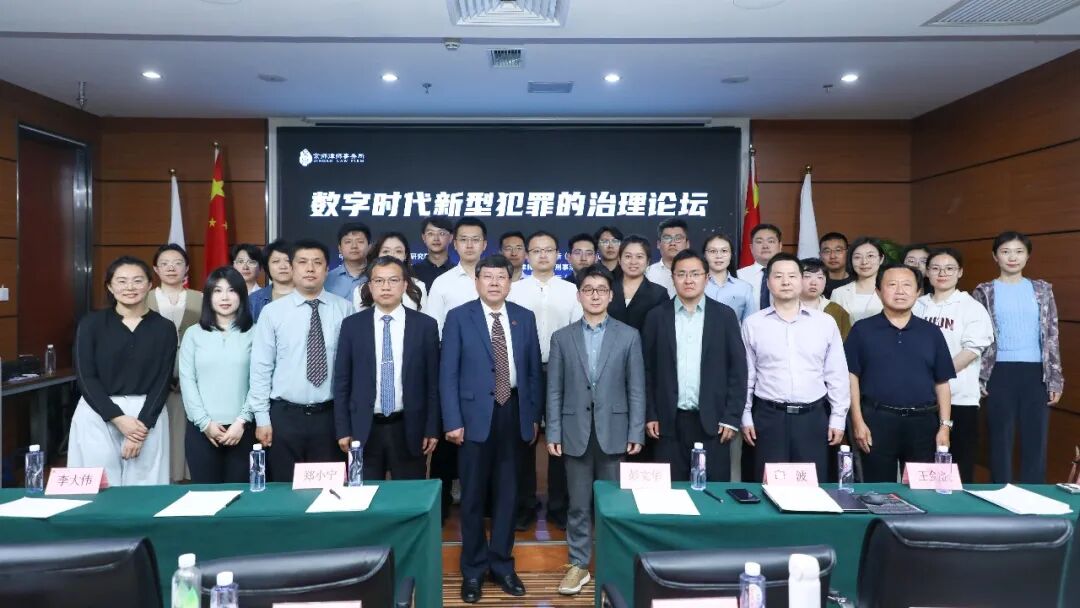
On 25 April 2026, the Forum on the Governance of New Types of Crime in the Digital Age was successfully held in Beijing. The forum was jointly organised by the Institute of Evidence Science at China University of Political Science and Law, the Centre for Financial Crime Research at China University of Political Science and Law, the Specialised Committee on Digital Crime Governance of the Chinese Society of Criminology, the Criminal Law Specialised Committee of JAVY Law Firm, the Criminal Committee of Beijing Jingshi Law Firm (National), and the Financial Crime Research Centre of the Criminal Committee of Beijing Jingshi Law Firm (National). The forum brought together numerous experts, scholars and practitioners from the legal community, with the aim of jointly exploring cutting-edge issues in the governance of new forms of crime in the digital age, and contributing insights to advance the refinement of legal regulations and the enhancement of governance capabilities.
Forum on the Governance of New Forms of Crime in the Digital Age · Opening
Tao Kuan, Equity Partner at Jingshi Law Firm and Deputy Director and Secretary-General of the Criminal Law Committee of Jingshi Law Firm (National), served as the host of the forum’s opening ceremony.
In his opening address, Peng Wenhua, Dean of the Institute of Evidence Science at China University of Political Science and Law and PhD supervisor, noted that the rapid development of science and technology has reshaped the structure of social production. The all-encompassing expansion of cyberspace, the pervasive penetration of big data, the continuous advancement of blockchain technology, and the widespread application of artificial intelligence have made our work and daily lives more convenient and efficient. At the same time, however, they have also provided opportunities for criminals to commit offences, leading to a situation where new forms and patterns of crime are proliferating unchecked. He emphasised that whilst encouraging technological innovation and promoting the healthy development of the digital economy, the major mission entrusted to legal professionals in the new era is to firmly uphold the bottom line of fairness and justice, effectively safeguard the public interest and the lawful rights and interests of citizens, and strike a balance between the proactive protection of technological innovation and the rigid constraints of legal rules. He expressed his hope that participants would speak freely, spark intellectual exchanges, and contribute insightful perspectives to the governance of digital crime.
Zheng Xiaoning, Deputy Secretary of the Party Committee and Executive Deputy Director of Jingshi Law Firm, as well as Honorary Director of the Criminal Law Committee of Jingshi Law Firm (National), stated that in this sweeping digital age, the widespread adoption of big data and generative artificial intelligence, coupled with the successive introduction of new regulations, has placed higher demands on national governance and public security, whilst also bringing profound changes to crime governance and the criminal justice sector. He believes that this forum is a significant manifestation of the deep integration of legal theory and practice, and hopes that participants will enhance the exchange of ideas and build consensus, whilst deepening cooperation in practice.
Forum on the Governance of New Types of Crime in the Digital Age · Session One
The first session of the forum was chaired by Liu Lihui, Deputy Director of the Criminal Law Committee at Jingshi Law Firm (National), Doctor of Law and Associate Professor.
Keynote Address
Lin Zhanfa, a PhD candidate in Law at China University of Political Science and Law and a lawyer at Fujian Shiyou Law Firm, delivered a presentation on the topic of ‘Intellectual Property Crime Risks and Countermeasures in the Application of Artificial Intelligence’. He conducted an in-depth analysis from three dimensions: the determination of copyright for AI-generated content, the boundaries of fair use in data training, and the risks of infringement in the autonomous execution of AI. Regarding generated content, he focused on the issue of defining “works” in the context of the intersection between civil and criminal law, pointing out that current regulations do not yet explicitly recognise non-human-created works, and that the definition of human creativity remains contentious. He illustrated his points by citing typical cases such as the 2025 AI-generated model infringement case. Regarding data training, he explored whether such activities could fall within the scope of ‘fair use’ and the concept of ‘transformative use’ under US law. Drawing on a case involving the unlawful acquisition of data from computer information systems, he analysed the evolution of traditional web scraping techniques and the challenges in their legal classification. Regarding autonomous execution, he proposed that responses should be formulated from three perspectives: the boundaries of use, protection rules, and legal mechanisms. He emphasised that when handling cases at the intersection of civil and criminal law, legal practitioners must possess a deep or foundational understanding of technical logic, and that only through hands-on experimentation can they grasp the matter with precision.
Wang Zichang, a PhD candidate in Law at China University of Political Science and Law, Senior Partner at JAVY Law Firm, and Deputy Director of the Digital Crime Governance Committee of the Chinese Society of Criminology, delivered a presentation on the topic of ‘Criminal Liability for Traffic Accidents Involving Autonomous Vehicles’. He noted that whilst autonomous driving is not a brand-new issue, the determination of liability has long remained unresolved, becoming a common challenge in both theory and practice. He systematically analysed a three-tier liability framework: regarding the liability of the auxiliary operator, traditional traffic accidents hold natural persons as the liable parties, whereas in autonomous driving scenarios, the driving entity changes; the auxiliary operator may claim exemption from liability based on reasonable reliance, but may bear legal liability under specific circumstances (such as unsuitable conditions at the time of activation or illegal modifications); Regarding the legal liability of artificial intelligence entities, the issue lies not in attribution but in attribution of liability; the AI entity itself lacks criminal capacity; concerning supplier liability, this involves two entities: the vehicle manufacturer and the AI entity supplier. The latter may invoke the defence of development risk, whilst algorithmic liability arising from unauthorised system upgrades constitutes the core issue. He also specifically addressed liability for the concealment of accident data, emphasising the importance of data governance and the dual value of data-sharing obligations.
Yu Xiu, a PhD candidate in Law at China University of Political Science and Law, delivered a presentation on the topic of ‘Criminal Law Protection of Personal Information in the Context of Generative Artificial Intelligence’. Starting from the current legal framework, she systematically revealed the multiple dilemmas encountered in practice. Firstly, personal information faces new risks in the context of generative AI, including obstacles to the application of the principle of informed consent, conflicts in the application of the principle of data minimisation, and a systemic escalation of the risk of data breaches. Secondly, current criminal law faces five key challenges in regulation: the characterisation of conduct, the attribution of liability to the perpetrator, the determination of violations of prior laws, the definition of the scope of affected subjects, and the assessment of causation. Building on this, she proposed a transformation of the regulatory model and the construction of a liability framework: the determination of conduct should be based on the materialisation of risk; the identification of objects should be defined by the integration of identification targets; causation should be constructed through a dual approach of normative causation and breach of duty; and normative integration should achieve a typological alignment for categorised protection. Finally, looking to the future, she suggested that the types of conduct would expand, assessment criteria would become more dynamic, and liability models would move towards specialisation.
Forum on the Governance of New Types of Crime in the Digital Age · Session Two
The second session of the forum was chaired by Zhao Bin, Director of the Financial Crime Research Centre at the Criminal Law Committee of Jingshi Law Firm (National).
Keynote Presentations
Yu Xiaoxi, a PhD candidate in Law at China University of Political Science and Law, delivered a presentation titled ‘The Dilemmas of Governing Juvenile Delinquency in the Digital Age and the Rule of Law Response’. Through typical cases such as property-related offences committed by minors across regions and cases involving nascent organised crime groups, she revealed new trends in juvenile crime in the digital age, as well as the severe challenges facing traditional governance models. Cases involving young offenders committing property crimes across regions have exposed barriers to evidence collection and regulation; the malicious distortion of legal protection provisions has created dual challenges regarding evidence gathering and case classification; whilst cases involving nascent organised crime gangs have highlighted discrepancies in the allocation of responsibility and the implementation of sanctions. Building on this, she proposed the following governance pathways: upholding the bottom line of criminal law and strengthening the tiered correctional system; enhancing procedural coordination to bridge the ‘last mile’ in law enforcement; deeply leveraging digital and intelligent technologies to reconstruct a comprehensive prevention and control network. She emphasised that the governance of minors requires striking a dynamic balance between the warmth of the rule of law and the baseline of order.
Dong Yuquan, a PhD candidate in Law at China University of Political Science and Law, Senior Partner at Jiangsu Bosida Law Firm, and Research Fellow at the Centre for Innovation and Development in Criminal Defence at China University of Political Science and Law, delivered a presentation titled ‘Substantive Expansion and Generalisation of Presumptions: A Re-examination of Securities Criminal Justice’. Drawing on the 55th batch of guiding cases, he analysed the overall landscape and judicial reasoning of four core categories of offences, whilst specifically dissecting the key points of contention and common judicial trends within the cases. He systematically highlighted prominent issues in the judicial determination of securities offences: regarding standards of proof, the boundaries between various types of securities products are blurred; the criminal law distinction between public and private offerings is confused; financing innovation for small and medium-sized enterprises is stifled; the concept of ‘substantive knowledge’ is being applied in an excessively broad manner; the identification of relevant parties is becoming vague; and a ‘one-size-fits-all’ approach to market capitalisation management leads to the misjudgement of legitimate transactions. Shortcomings also exist in the areas of evidentiary rules and the attribution of subjective culpability. He analysed these issues from their institutional roots—namely, a shift in judicial philosophy from prudence to strict enforcement, an imbalance in administrative coordination mechanisms, an absolute prioritisation of investor protection, a lack of regulatory provision, and the driving forces of judicial performance assessments and case-handling pressures—and proposed pathways for improvement based on this analysis.
Li Ya, a PhD candidate in Law at China University of Political Science and Law, delivered a presentation on the theme of ‘Building a Treasury System for Central State-Owned Enterprises in the Context of Digital Transformation’. She began by outlining the background and essence of treasury system development, noting that it represents a contemporary imperative driven by both state-owned asset supervision and digital transformation, and elaborated on the four key development requirements and the historical evolution of the system. This system effectively addresses three core issues: inadequate group-wide control and diminished control efficacy; prominent departmental barriers and significant data silos; and lagging ex-post supervision and weak risk prevention and control. Building on this, she further analysed the practical challenges: at the theoretical level, the dilemma of balancing regulatory penetration with corporate independence; at the international level, the obstacles to penetrative regulation posed by international rules; and at the technical level, the lack of self-reliance and control in digital development. In response to these issues, she proposed optimisation pathways at the legal level, including establishing coordination mechanisms, aligning with international rules, and strengthening self-reliance and control.
Forum on the Governance of New Types of Crime in the Digital Age · Guest Commentary
Peng Wenhua, Dean of the Institute of Evidence Science at China University of Political Science and Law, Professor and PhD supervisor, provided a commentary on the keynote speeches at this forum. He noted that the research findings presented by the speakers demonstrated a comprehensive understanding and diverse perspectives, reflecting serious consideration of the challenges of crime governance in the digital age. The presentations encompassed both cutting-edge theoretical exploration and practical case analyses, demonstrating a strong problem-solving orientation. At the same time, he noted that the boundaries of certain topics still require further clarification, the practical applicability of some discussions at this stage warrants consideration, and the issue of aligning theoretical tools with new technologies remains worthy of ongoing attention. Overall, these studies provide a solid foundation for further in-depth exploration.
In his commentary, Yin Bo, Director of the Centre for Financial Crime Research at China University of Political Science and Law, Professor and PhD supervisor, acknowledged the positive significance of the presentations at this forum. He noted that the topics chosen by the speakers were closely aligned with the practical needs of criminal law in the digital age, with a strong integration of theory and practice, and that the construction of liability frameworks exhibited distinct characteristics. The research findings demonstrate a degree of critical awareness and reference value, with some topics opening up new perspectives. At the same time, he suggested that the scope of certain research topics could be broadened appropriately, that the rigour of theoretical analysis could be enhanced, and that policy recommendations could be formulated in a more concrete and pragmatic manner. He expressed his hope that the speakers would continue to build upon their existing work to produce more mature research outcomes.
Wang Jianbo, Professor and PhD supervisor at the School of Law, Capital University of Economics and Business, and Chair of the Digital Crime Governance Committee of the Chinese Society of Criminology, provided a comprehensive commentary on the presentations at this forum. He commended the presenters for identifying some of the core challenges in crime governance in the digital age, such as the lengthening of causal chains and the fragmentation of responsible parties. The presentations balanced theoretical reflection with practical considerations, and the research approaches and perspectives were highly illuminating. At the same time, he suggested that there could be a closer alignment between risk response and problem analysis; certain topics could focus more on new types of cases arising in the digital age, and ideas from specific specialised fields are worthy of wider dissemination. If empirical data can be continuously accumulated in the future, the research outcomes will be even more robust.
The successful hosting of this “Forum on the Governance of New Types of Crime in the Digital Age” has provided a high-level platform for exchange between legal experts, scholars and practitioners, effectively promoting in-depth discussion and the exchange of ideas on the governance of new types of crime in the digital age. Participants unanimously agreed that the governance of new types of crime in the digital age requires not only legal norms that keep pace with the times, but also the effective application of technological means, and cannot be achieved without deep collaboration between academia and the legal profession.
Looking ahead, JAVY Law Firm will continue to join forces with all stakeholders to build a hub for industry-academia-research collaboration, break down the barriers of the times, actively address the challenges posed by new forms of crime in the digital age, and make greater contributions to maintaining social stability and public safety.


© Beijing JAVY Law Firm Beijing ICP Registration No. 18018264-1


