


In the practical course of corporate operations, the prevention and identification of legal risks are of paramount importance, with the prevention and response to corporate crimes being particularly critical. China's Criminal Law adopts a dual-penalty system for corporate crimes, meaning that once a company becomes involved in such cases, not only does the enterprise itself bear corresponding criminal liability, but relevant responsible personnel may also face legal sanctions. This makes it all the more urgent for companies, when confronted with complex legal risks, to seek the assistance of professional solicitors. Consequently, practising solicitors must not only possess a solid foundation of legal knowledge but also demonstrate keen awareness in identifying corporate crimes and masterful defence techniques to deliver comprehensive, high-quality legal services to enterprises.
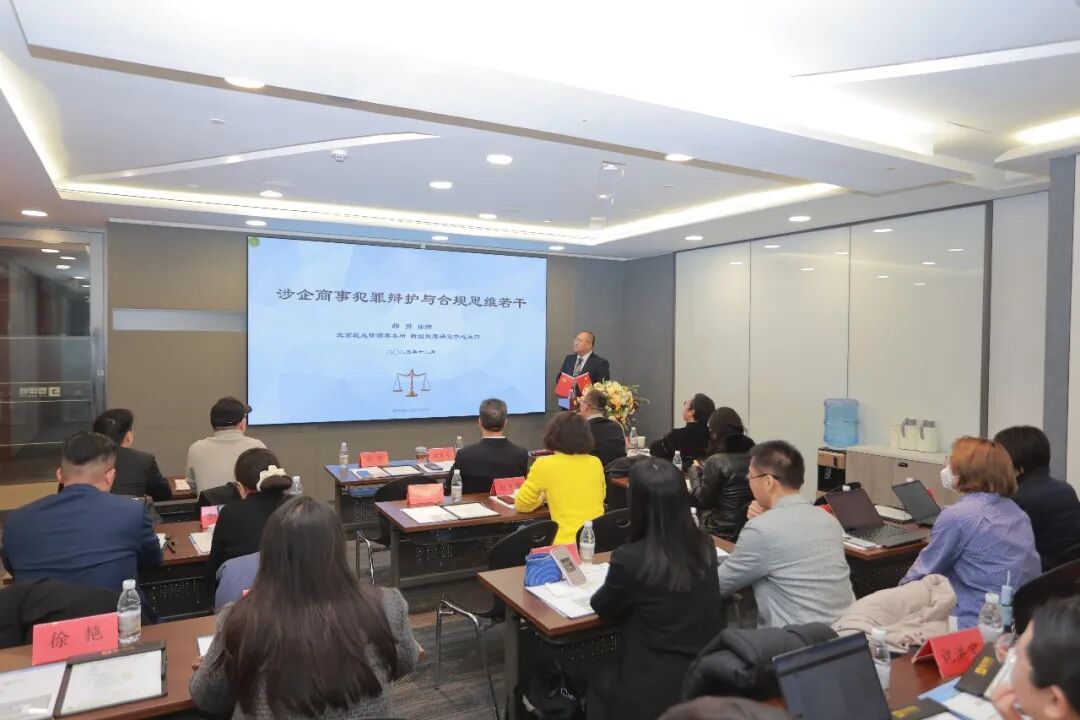
To enhance lawyers' professional competence and service capabilities in the field of corporate commercial crime, thereby supporting enterprises in achieving compliant and stable development, JAVY Law Firm successfully hosted the event ‘Defence Strategies and Compliance Thinking in Corporate Commercial Crime’ on 18 December 2025. Mr Xu Fadong, Executive Committee Member and Senior Partner of Jiawei Law Firm, delivered the opening address. The event featured a keynote presentation by Dr Hao Yun, Director of the Centre for Emerging Crimes Research at Beijing Qiancheng Law Firm, Criminal Law Editor of Peking University's Yanda Law Journal, and Research Fellow at the Beijing Lawyers' Law Research Association.
At the outset, Mr Xu extended a warm welcome to all attendees on behalf of JAVY Law Firm. He noted that since its inception, the JIA LAWYER Lecture Series had successfully hosted twelve engaging events, attracting a cumulative total of 800 participating lawyers, with over 200 joining virtually. Open to legal practitioners across Beijing and nationwide, the series has garnered significant acclaim within the profession for its substantive content and professional discourse. Mr Xu encouraged active participation and open discussion among attendees to collectively advance the legal sector.
During the thematic sharing session, Mr Hao Yun drew upon representative cases from his own practice. Using several successful defence strategies across areas including corporate commercial crimes, bill of exchange and financial crimes, market order offences, official misconduct, cybercrimes, intellectual property crimes, smuggling offences, and litigation-related crimes as a framework, he provided a detailed breakdown of effective legal solutions. This analysis covered two dimensions – criminal defence and legal risk compliance prediction – and three levels: substantive law, procedural law, and evidence law. detailed the legal strategies that yielded effective outcomes such as acquittals, reduced charges, mitigated sentencing, and compliant legal risk prevention.
In this lecture, Solicitor Hao Yun elaborates on eighteen strategic approaches distilled from his case practice in handling commercial crimes, corporate offences, and cases involving the intersection of criminal, civil, and administrative law. These include: 1. A pragmatic, equitable normative purpose approach that traces theoretical foundations back from social outcomes and criminal policy; 2. A dynamic evaluation of orderly legal interests through contextual, iterative, and functional lenses; 3. The approach of comprehensively employing the discovery and balancing of legal interests to deconstruct and select protected interests; 4. The substantive approach to criminal-civil-administrative intersections, which seeks normative clarity in civil, commercial, and administrative laws where criminal law is ambiguous, and uses the principle of proportionality to narrow the scope of criminal charges; 5. The approach of translating concepts such as the restraint of criminal law into concrete, visible, and persuasive normative bases; VI. A tiered, layered approach to structuring defence strategies; VII. A dialectical understanding of how changes in civil, commercial, and administrative laws impact criminal legal risks; VIII. A mindset that accurately distinguishes between analogous cases and analogous judgments through the correlation of elements and legal interests; IX. A mindset that employs the interpretation of conflicting obligations to define criminal composition; 10. The approach of adhering to rights-based and preparatory duty-based principles to transform acts of commission into acts of omission in defence strategies, thereby mitigating risks and resisting undue scrutiny; 11. The approach of scrutinising inconsistencies in normative documents regarding the division of roles among accomplices, co-conspirators, and other participants; 12. The approach of examining issues in normative documents' ‘Interpretation and Application’ sections where explanations are provided for matters too contentious to be codified; 13. The approach of prohibiting and excluding double evaluation; 14. The mindset of meticulously scrutinising evidence from both substantive and procedural dimensions; Fifteen. The mindset of evidence gatekeeping and bottom-line proof in managing voluminous evidence reviews; Sixteen. The mindset of leveraging shifts in criminal policy across different periods and corresponding windows of opportunity to bolster defence arguments; Seventeen. The mindset of personifying corporate criminal liability; Eighteen. The defence mindset of limiting regulatory objectives based on normative clarity versus the compliance mindset of extending regulatory objectives based on normative coherence.
This event proved exceptionally substantive and rich in practical insights, earning unanimous acclaim from attending solicitors. Participants unanimously affirmed that the presentations combined theoretical depth with practical application, clarifying approaches and charting directions for efficiently handling corporate commercial cases in future.
JAVY Law Firm remains steadfast in its commitment to establishing platforms for interaction between solicitors and distinguished legal institutions and industry luminaries. This fosters individual professional development, deepens legal expertise and skills, and empowers solicitors in their professional advancement.
© Beijing JAVY Law Firm Beijing ICP Registration No. 18018264-1


