


[Abstract] “Nominal legal representatives” have long faced the dilemma of being unable to resign. On December 4, 2025, the Supreme People’s Court issued the revised “Provisions on the Classification of Civil Cases,” which, under the category of “Disputes Concerning Requests to Change Company Registration,” introduced for the first time an independent fourth-level classification—“Disputes Concerning the Removal of Company Registration (Filing).” This provides a clearer legal basis for parties seeking the removal of such registrations.
This case, represented by attorneys Zhang Li and Yang Jingrui of JAVY Law Firm, is a landmark precedent in which the registration of a legal representative was successfully revoked following the establishment of this new case category; it appears to be the first of its kind to date. Its uniqueness lies in the fact that, during the litigation process, the defendant company was ordered to undergo bankruptcy liquidation, raising the question of whether the proceedings should be stayed. In this situation, the plaintiff proactively communicated with the bankruptcy administrator to monitor the progress of asset takeover, thereby providing procedural safeguards for the court’s smooth adjudication; the period from the acceptance of the bankruptcy petition to the court hearing was only 30 days. The judicial ruling centered its reasoning on the standard of “substantive relevance,” clarifying the impact of the bankruptcy administrator’s status of asset takeover and substantive stance on the litigation process and the outcome of the judgment. It also established a clear enforcement pathway linking “judgment—notice of assistance in enforcement—cancellation of registration with the industrial and commercial authorities,” achieving favorable legal and social outcomes.
01 Key Points of the Ruling
Standard of Substantive Connection: A legal representative must have a substantive connection with the company, primarily manifested through actual participation in the company’s management and operations. When the former legal representative no longer holds a position in the company, is not a shareholder, has not received compensation, has transferred their social insurance registration, and the company has entered bankruptcy liquidation proceedings—and there is no longer any realistic possibility of removing the registration through the company’s internal governance mechanisms—the People’s Court shall support the request for removal in accordance with the law.
Rules on Removal in Bankruptcy Proceedings: After the bankruptcy case is accepted, if the administrator has taken control of the company’s seals, books, and assets prior to the hearing and appears in court to defend the case, the litigation need not be stayed, and the People’s Court shall proceed with the hearing. Whether the bankruptcy administrator objects to the claims falls within the scope of substantive defense and does not affect the court’s independent adjudication based on the “substantive relevance” standard, nor does it constitute grounds for preventing the continuation of the proceedings.
Enforcement Procedure: After the judgment takes effect, the People’s Court issues a notice of assistance in enforcement upon application. The market supervision and administration department shall, in accordance with this notice, process the removal registration and amend the legal representative’s registration details to “removed pursuant to the People’s Court’s notice of assistance in enforcement.”
02 Basic Case Facts
The plaintiff, Mr. Wang, was formerly the head of a certain newspaper. In 2015, the defendant, a certain technology company (hereinafter referred to as the “Technology Company” or the “Company”), was established. Mr. Wang was appointed by a certain newspaper to serve as a director, chairman, and legal representative of the Company. In January 2018, the plaintiff was removed from his position as head of the newspaper; on April 12 of the same year, the newspaper served the defendant Company with a “Notice Regarding the Replacement of Company Directors,” appointing another person to succeed the plaintiff as director and explicitly stating that “the succession takes effect immediately.” On May 16, 2018, the Company’s board of directors passed a resolution via a WeChat meeting confirming the appointment of another individual as chairman and legal representative. However, the Company never filed for a change of legal representative with the market supervision authorities. The plaintiff never entered into an employment contract with the defendant Company, received no remuneration, and his organizational, personnel, and social security relationships were not with the defendant Company. In March 2021, the plaintiff was officially transferred from a certain newspaper and ceased to have any affiliation with the defendant company or its affiliated entities. Subsequently, the defendant company faced compulsory enforcement by multiple courts due to debt disputes. As the registered legal representative, the plaintiff was issued consumption restriction orders by 17 courts, prohibiting him from traveling by airplane, high-speed rail, and other modes of transportation, thereby disrupting his normal work and daily life. The plaintiff repeatedly requested that the defendant company process the removal of his registration as legal representative, but the defendant company failed to do so.
On April 26, 2025, the plaintiff filed a lawsuit with the Chaoyang District People’s Court of Beijing, requesting that the court order the defendant to remove the plaintiff’s registration as legal representative. It was established that the defendant company’s business license was revoked on June 28, 2022, and on December 22, 2025, the Beijing No. 1 Intermediate People’s Court ruled to accept the bankruptcy liquidation case and appointed a liquidator. Prior to the hearing, the bankruptcy administrator had taken possession of the company’s seals, ledgers, and other key documents and assets, and appeared in court on January 21, 2026, to respond to the lawsuit.
03 Judgment
On January 30, 2026, the Chaoyang District People’s Court of Beijing issued Civil Judgment No. (2025) Jing 0105 Min Chu 81006:
The defendant technology company shall, within seven days after this judgment takes effect, remove Mr. Wang, the plaintiff, from the business registration records as the legal representative of the defendant company.
The defendant shall bear the case filing fee of 70 yuan.
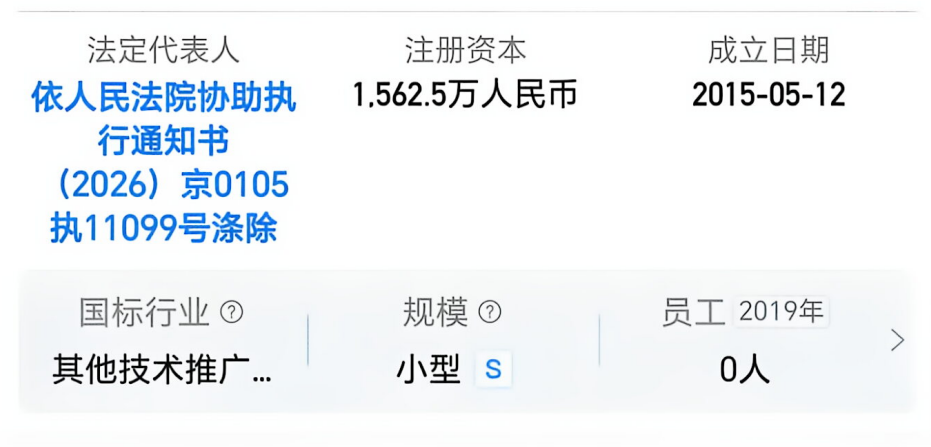
After the judgment took effect, the plaintiff applied for compulsory enforcement. The Chaoyang District People’s Court of Beijing issued a notice of assistance in enforcement, and the market supervision and administration department has now completed the removal of the registration. The Enterprise Credit Information Publicity System now displays: “Legal Representative: Removed pursuant to the People’s Court’s notice of assistance in enforcement.”
04 Rationale for the Judgment
On the Necessity of Judicial Intervention
The Chaoyang Court held that although changing a legal representative falls under corporate autonomy and judicial intervention should be exercised with caution, judicial intervention becomes necessary when conflicts of interest between the legal representative and the company cannot be resolved through corporate autonomy mechanisms, or when all available remedies under corporate autonomy have been exhausted without resolution.
Based on the evidence on file and the actual circumstances of Mr. Wang and the defendant technology company, Mr. Wang was dispatched by a certain newspaper—a subsidiary media outlet under a certain group—to serve as a director of the technology company, where he was elected as chairman and became the legal representative. In March 2021, Mr. Wang’s social security contributions were no longer made by the certain group, and there is no other evidence to prove that Mr. Wang currently maintains any substantive connection with the technology company. In December 2025, the Beijing No. 1 Intermediate People’s Court issued a civil ruling stating that the technology company had legally entered bankruptcy liquidation proceedings. Consequently, regarding Mr. Wang’s request to remove him as the legal representative, it is currently difficult to secure a resolution from the company’s shareholders’ meeting or board of directors. For this reason, it is necessary for him to file a commercial registration lawsuit to remove his status as legal representative.
Regarding the Standard of “Substantive Connection”
Under the Company Law, the legal representative is appointed from among the directors or managers in accordance with the company’s articles of association. The Company Law and the articles of association also specify the specific powers and duties of the chairman, directors, and managers. Therefore, from the legislative intent of the legal representative system, there must be a substantive connection between the legal representative and the company. The Company Law requires that the legal representative of a company be held by a person in a specific position, who shall exercise the company’s operational management and decision-making powers in accordance with the law. Consequently, the substantive connection between the legal representative and the company is primarily reflected in the legal representative’s participation in the company’s operational management.
Based on the facts established in this case, Mr. Wang currently holds no position at the technology company and is not a shareholder. Given that the technology company has entered bankruptcy liquidation proceedings, it is difficult to remove the legal representative through internal corporate governance remedies. Under these circumstances, if the judiciary does not intervene, Mr. Wang, as an ordinary citizen, would have no means of redress for his legitimate rights and interests. Therefore, this Court supports Mr. Wang’s claim to remove the legal representative from the corporate registry.
05 Case Analysis
Definition and Legal Basis of “Disputes Concerning the Cancellation of Company Registration”
On December 4, 2025, the Supreme People’s Court issued the revised “Provisions on the Classification of Civil Cases.” Under the third-level category “292. Disputes Concerning Requests to Amend Company Registration,” it added for the first time an independent fourth-level category: “Disputes Concerning the Cancellation of Company Registration (Filing).” This new regulation officially took effect on January 1, 2026.
Article 10 of the “Company Law of the People’s Republic of China” (2023 Revision) stipulates: “The legal representative of a company shall be a director or manager who represents the company in the conduct of its affairs, in accordance with the provisions of the company’s articles of association.” This provision establishes the requirement for a substantive connection between the legal representative and the company, providing a substantive legal basis for disputes regarding the removal of registration.
Based on the above provisions and through legal research, it can be confirmed that this case is a typical example of a legal representative’s dispute over the cancellation of registration arising during bankruptcy liquidation proceedings following the explicit establishment of the “Disputes Regarding the Cancellation of Company Registration (Filing)” case category under the new regulations.
Rules for Adjudicating Cancellation Lawsuits in Bankruptcy Proceedings
Article 20 of the Enterprise Bankruptcy Law of the People’s Republic of China provides: “After a people’s court accepts a bankruptcy petition, any civil litigation or arbitration concerning the debtor that has commenced but has not yet been concluded shall be suspended; after the administrator takes control of the debtor’s property, such litigation or arbitration shall resume.” This provision addresses the transition between “suspension” and “resumption,” but in practice, the key issues lie in when “takeover” is completed and the time limits for “resuming proceedings.”
The plaintiff received a summons for a court hearing on January 4, 2026, and subsequently learned through online sources that the defendant had entered bankruptcy proceedings on December 22, 2025—leaving only 30 days until the originally scheduled hearing date (January 21, 2026). If this case is not properly coordinated with the defendant’s bankruptcy proceedings, it will be difficult for the plaintiff to realize their rights and interests in the short term. The plaintiff’s counsel proactively contacted the trustee to monitor the progress of the takeover of the debtor’s assets and cooperated with the trustee to complete relevant procedural matters. Subsequently, the counsel promptly reported to the court on the trustee’s completion of the takeover of key materials—such as the company seal and accounting books—and assets, enabling the trial to proceed smoothly. This practice demonstrates that after the filing of a bankruptcy petition, as long as the trustee completes the statutory takeover before the hearing, the litigation may continue without the need for a stay of proceedings.
The reasoning in this case indicates that whether the bankruptcy administrator objects to the claims falls within the scope of substantive defense and does not affect the court’s independent adjudication based on the “substantive connection” standard. This rule clarifies the role of the bankruptcy administrator in derivative actions—its core obligation is to represent the debtor in the proceedings, rather than to make a final determination on whether a substantive connection exists between the plaintiff and the company.
Application of the “Substantive Connection” Standard in the Context of Bankruptcy
The “substantive connection” standard is a core rule for resolving disputes over the removal of directors from the corporate registry, derived from the legislative intent of Article 10 of the Company Law of the People’s Republic of China. In determining whether a “substantive connection” exists, the following factors must be comprehensively examined:
Whether the appointment relationship has been lawfully terminated. In this case, on April 12, 2018, a certain newspaper served the defendant company with a “Notice Regarding the Replacement of Company Directors,” appointing another person to succeed the plaintiff as a director, with the “succession taking effect immediately.”
Whether the individual actually participated in business management. Since the termination of the appointment relationship in April 2018, the plaintiff has not held any position at the defendant company, has not received any compensation, and has not participated in any business management activities.
Whether there are personal or property ties to the company. The plaintiff’s social security contribution records show that from January 2015 to March 2021, the entity responsible for his social security contributions was a certain newspaper group. After March 2021, he was transferred and no longer has any organizational, personnel, or financial ties to the defendant company or its affiliated entities.
Whether there are any malicious circumstances, such as evading debt. The plaintiff served as the legal representative passively and had no subjective intent to evade responsibility.
In the context of bankruptcy, the judgment explicitly states: “Mr. Wang currently holds no position at the technology company nor is he a shareholder. Given that the technology company has entered bankruptcy liquidation proceedings, it is difficult to remove the legal representative through internal corporate governance remedies.” Accordingly, it can be understood that the appointment of a bankruptcy administrator does not imply that the former legal representative has reestablished a connection with the company. While the administrator represents the debtor in litigation, this does not alter the fundamental fact that there is no longer any substantive connection between the plaintiff and the company. The plaintiff’s counsel repeatedly argued before the court that, without judicial intervention, even if the bankruptcy administrator agreed to process the removal procedures, the removal and registration of the change could not be effectively accomplished; this argument was supported by the court.
Representation Strategy and Implementation Path
(1) Evidence Strategy: Establishing a Comprehensive Evidence Chain
Focusing on the central theme of “proving that the plaintiff no longer has a substantive relationship with the company,” the legal representative systematically organized and submitted key evidence, including proof of the termination of the appointment relationship, internal company resolutions, social security transfer records, documents regarding the company’s operational status, and 17 consumption restriction orders. This evidence fully corresponded to the factual basis acknowledged by the administrator and established in the court’s ruling.
(2) Procedural Strategy: Proactively Coordinating with the Administrator to Ensure the Litigation Proceeds
After the defendant company entered bankruptcy proceedings, the legal counsel immediately took the initiative to contact the bankruptcy administrator, submitted a complete set of litigation materials, and urged the administrator to complete the takeover and ensure the company’s representative appeared in court to defend the case prior to the hearing. This created the conditions for the court to continue the proceedings without suspension.
(3) Enforcement: The Practical Approach to Discharge Registration
Practice has shown that after a judgment takes effect, the discharge registration cannot be processed through voluntary compliance procedures by both parties. Consequently, applying for compulsory enforcement—where the court issues a Notice of Assistance in Enforcement and the market supervision authority processes the deregistration through enforcement procedures—became the only viable option. On May 12, 2026, the Business Registration Publicity System displayed “Deregistered pursuant to the People’s Court Notice of Assistance in Enforcement (2026) Jing 0105 Zhi 11099” for both the “Chairman” and “Legal Representative” fields, thereby fulfilling the client’s requirements.
Relevant Legal Provisions:
Article 10 of the Company Law of the People’s Republic of China (2023 Revision)
The legal representative of a company shall be a director or manager who represents the company in the conduct of its affairs, in accordance with the provisions of the company’s articles of association.
If a director or manager serving as the legal representative resigns, such resignation shall be deemed to include resignation from the position of legal representative.
If the legal representative resigns, the company shall appoint a new legal representative within thirty days from the date of the resignation.
Article 20 of the Enterprise Bankruptcy Law of the People’s Republic of China
After a people’s court accepts a bankruptcy petition, any civil litigation or arbitration concerning the debtor that has commenced but has not yet been concluded shall be suspended; such litigation or arbitration shall resume after the administrator takes control of the debtor’s property.
Supreme People’s Court “Provisions on the Classification of Civil Cases” (Issued on December 4, 2025)
292. Disputes Regarding Requests to Amend Company Registration
(1) Disputes Regarding the Cancellation of Company Registration (Filing)


© Beijing JAVY Law Firm Beijing ICP Registration No. 18018264-1


