


Recently, Ms. Cao Chunfang, Executive Director of JAVY Law Firm, and Ms. Tian Qiuying, Partner, jointly represented a natural person in the reconsideration proceedings of a judicial detention case, successfully overturning the judicial detention order.
Case Summary
Mr Zhang (pseudonym) became a subject of enforcement proceedings following a dispute. During the enforcement process, Mr Zhang and other subjects paid partial enforcement sums and provided immovable property and motor vehicles for court auction, after which the enforcement proceedings concluded. Shortly thereafter, Zhang suddenly received a detention order, which imposed a 15-day detention on the grounds of his refusal to comply with the effective judgment. Simultaneously, Zhang's relative, Liu (pseudonym), received a detention order imposing a 15-day detention on the grounds of assisting Zhang in refusing to comply with the effective judgment.
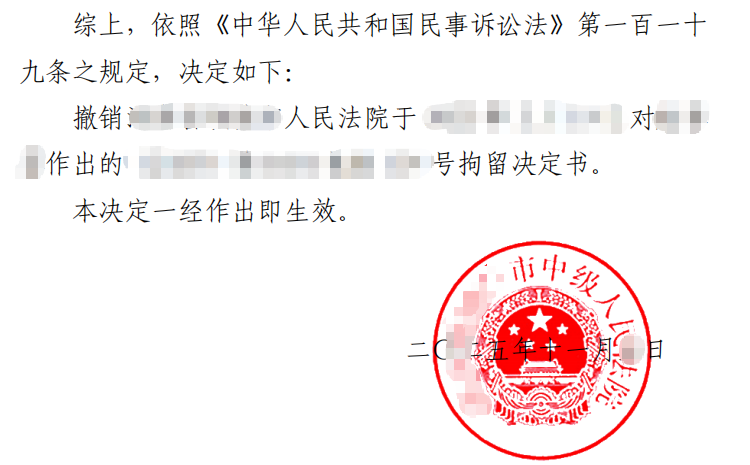
Upon accepting the mandate, the solicitor assisted the client in filing a review application within the statutory timeframe. The application argued that the enforcement case had already seized sufficient assets, recovered millions of yuan in payments, concluded prior to the service of the judicial detention order due to reasons attributable to the applicant, lacked evidence of obstruction of enforcement, and that personal penalties should be applied with restraint. It contended that the judicial detention order should be revoked. Ultimately, the review court upheld these arguments and revoked the judicial detention order.
Counsel contends that judicial detention constitutes a custodial judicial sanction closely linked to the offence of refusing to execute a court order. Consequently, such detention must be decided with utmost caution and issued only where substantial evidence demonstrates the debtor's obstruction of enforcement proceedings. It cannot be imposed solely on the grounds that the case has not achieved full recovery of funds. In this case, the debtor had already discharged millions of yuan in debts, with substantial assets under their name remaining seized but unsold. Moreover, the enforcement proceedings had concluded prior to service of the detention order due to the applicant's actions. The detention order failed to describe ‘how the debtor obstructed or assisted in obstructing’ enforcement, nor did it present relevant evidence. Under these circumstances, the decision to impose judicial detention on grounds of refusal to perform/aiding refusal to perform is indeed problematic. The reconsideration court's ruling demonstrates objectivity and impartiality.
Translated with DeepL.com (free version)


© Beijing JAVY Law Firm Beijing ICP Registration No. 18018264-1


